Listening to the Unheard: An Editorial Review of The Voice Of Those Who Raced; What They Would Have To Say
The Voice Of Those Who Raced; What They Would Have To Say by E. Kaaviya is a poetry narrative that adopts an unusual but purposeful perspective: the lived experience of a racehorse within the racing industry. Written entirely from the horse’s point of view, the book positions itself less as a traditional poetry collection and more as a sustained act of witness and protest.
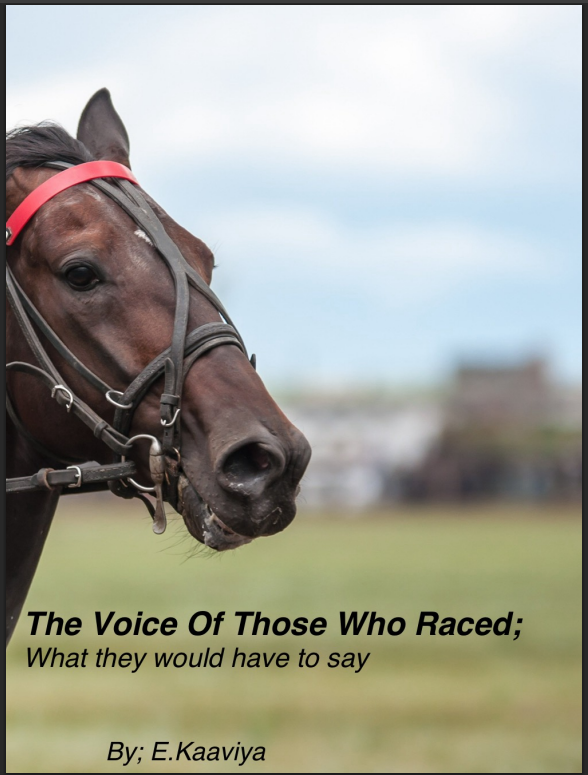
Structurally, the book unfolds as a sequence of short poetic episodes, each tracing a stage in the horse’s life—from birth and early freedom to training, racing, injury, disposal, and eventual rescue. The language is deliberately simple and direct, often prioritizing emotional immediacy over technical polish. Kaaviya makes it clear that grammatical irregularities and rough edges are intentional, meant to preserve the illusion of a non-human narrator rather than conform to literary refinement. This choice will divide readers: some may find the style raw and repetitive, while others will recognize it as integral to the book’s ethical stance.
What gives the work its force is consistency of voice. The narrator’s confusion, fear, resignation, and brief moments of hope remain emotionally coherent across the text. Scenes involving training practices, whips, injuries, forced separation of foals, and “wastage” are presented without metaphorical softening. The repetition of cruelty is not accidental; it mirrors the systemic nature of the industry being critiqued. At times, the narrative risks monotony, but this, too, feels aligned with the author’s intent—to make the reader sit with discomfort rather than consume it as entertainment.
The book is at its strongest when it resists sensationalism. The most affecting moments are often the quietest: the absence of comfort after a race, the normalization of suffering, and the contrast between human celebration and animal pain. The final movement toward rescue and rehabilitation offers relief without erasing what came before, framing survival as exception rather than rule.
As an ARC, the work reads as a manifesto-in-progress—less concerned with literary perfection than with ethical clarity. It asks readers not merely to empathize, but to reconsider an industry normalized through spectacle.